
Why STEM Learning Benefits Kids From an Early Age
The case for early exposure to science and math enrichment is well-supported in education research. A longitudinal study published through the American Educational Research Journal found that early math skills in kindergarten were among the strongest predictors of academic achievement through eighth grade (Duncan et al., 2007, AERJ). This is not simply because math builds on itself, though it does. It is because early problem solving education teaches children how to think systematically and persist through challenge.
Science instruction works similarly. According to the National Science Teaching Association, children who engage in hands-on science learning during the elementary years develop stronger observational skills, better academic language, and greater scientific curiosity that carries into secondary school (NSTA, nsta.org). The window between preschool and fifth grade is particularly important, because young brains are wired for sensory exploration and pattern recognition.
The STEM learning benefits kids experience in these early years extend well beyond academic scores:
- Children build the ability to tolerate ambiguity and work through problems that do not have a single correct answer
- They develop language and reasoning skills as they explain their observations and hypotheses
- They learn to collaborate, revise their thinking, and communicate results to others
- They experience the connection between effort and discovery, which strengthens intrinsic motivation
What Hands-On Science Learning Actually Looks Like
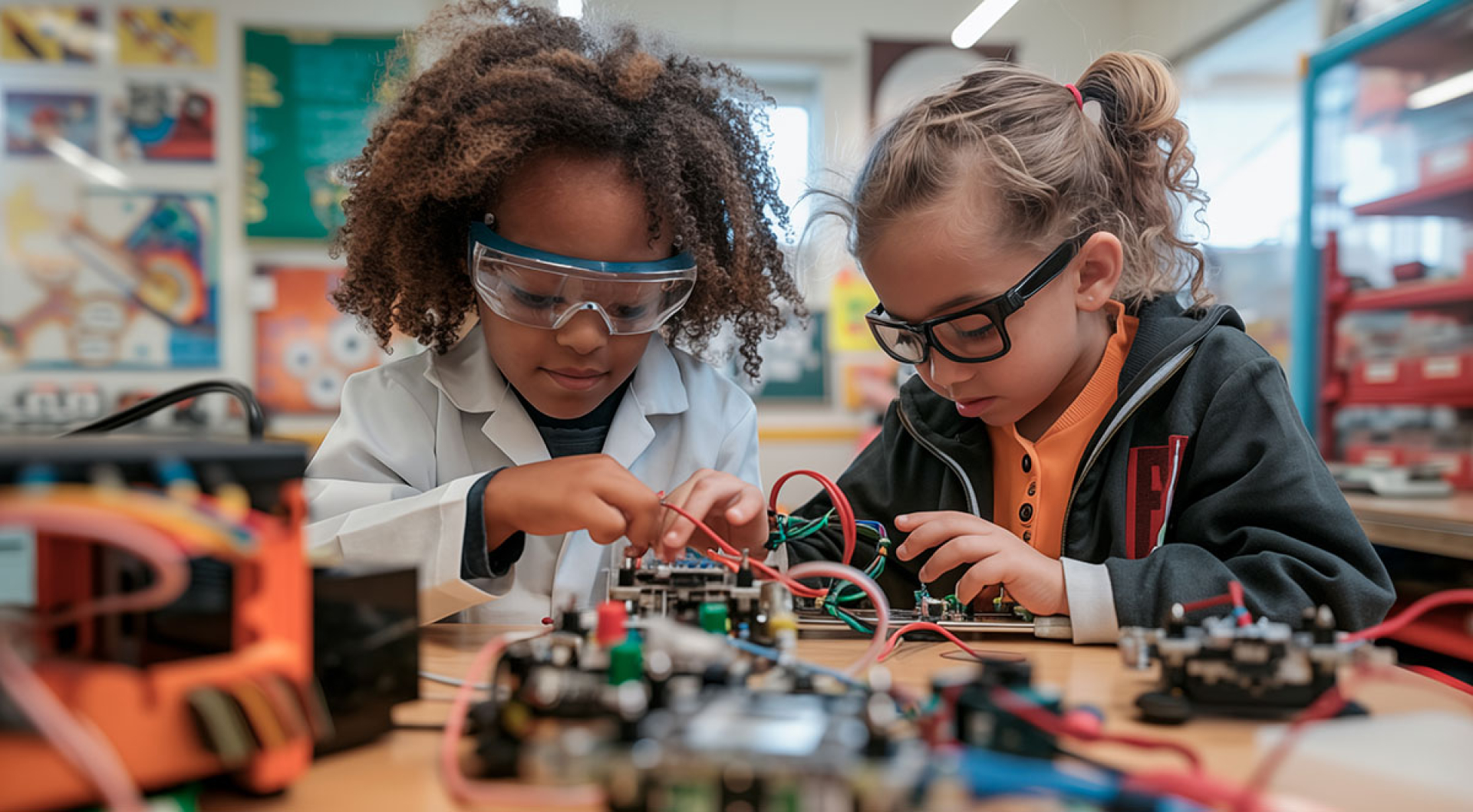
There is an important difference between learning about science and doing science. Hands-on science learning puts children in the role of investigator rather than audience. They are measuring, predicting, observing outcomes, and drawing conclusions from evidence they gathered themselves.
Project-based learning elementary approaches take this a step further by anchoring instruction in a real-world question or challenge that unfolds over days or weeks. Instead of completing a worksheet on gravity, a class might spend two weeks designing and testing different kinds of structures, recording their data, revising their prototypes, and presenting their findings to the class. This experiential learning approach mirrors how professionals in every STEAM field actually work.
The research on project-based learning is compelling. According to a peer-reviewed study published in the Journal of Educational Psychology, students in project-based learning classrooms demonstrated stronger content mastery and significantly higher scores on tests of critical thinking skills compared to peers in traditional instruction settings (Han et al., 2015, APA PsycNet). The reason seems straightforward: when children invest in a question they find genuinely interesting, they engage more deeply with the content needed to answer it.
The Role of Technology in the Classroom
Technology in the classroom, when used thoughtfully, extends what students can investigate and create. At the elementary level, this does not mean replacing hands-on exploration with screens. It means using digital tools to support inquiry, organize data, and connect ideas. A child who uses a tablet to record observations during a science experiment is using technology as a thinking tool, not a passive entertainment device.
The International Society for Technology in Education notes that meaningful technology integration develops digital fluency alongside content knowledge, preparing students for a world where both are necessary (ISTE, iste.org). For elementary students, learning to navigate these tools with intention is itself a 21st century skill that will serve them in every subject area and eventually in their careers.
Research from the Brookings Institution has found that technology integration is most effective when it is paired with high-quality instruction and clear academic goals, rather than deployed as a standalone initiative (Brookings, 2019, brookings.edu). In other words, the teacher and the learning design matter as much as the tool itself.
Science and Math Enrichment Within a Christian Framework
For families seeking STEAM education elementary school experiences that also nurture faith, the question is not whether a Christian school can offer rigorous science and math enrichment. The question is how those disciplines deepen a child's understanding of God's creation and their own calling within it.
At St. Paul Lutheran School in Royal Oak, science instruction is built around significant hands-on learning and experimentation across all grade levels. The school's science curriculum includes general science, health, and computer education, taught within a Christian atmosphere where academic inquiry and faith formation are understood as complementary rather than competing.
Technology integration begins in kindergarten and develops progressively through eighth grade. Students in kindergarten through fourth grade receive specific instruction in how to use technological devices such as Chromebooks. From fifth grade onward, students use those devices as tools for research and document production, building the kind of independent, purposeful technology use that supports both academic growth and 21st century skills development.
This approach reflects a broader conviction at St. Paul: that educating the whole child means developing the mind, body, and spirit together. Science is not just a subject to be studied. It is a way of marveling at a world that has been thoughtfully made, and problem solving is a way of exercising the stewardship and creativity that every student is called to practice.
Read our blog about how private schooling influences a student’s future family lives.
Building Critical Thinking Skills That Last
One of the most widely cited benefits of STEAM education is its impact on critical thinking skills. The World Economic Forum has consistently ranked critical thinking and complex problem solving among the top skills employers expect from the workforce of the future (WEF Future of Jobs Report, weforum.org). The earlier children are taught to think critically, the more naturally those habits take root.
What does critical thinking look like in an elementary STEAM context? Consider the sequence of skills a child exercises when working through a science investigation:
- Identify a question or problem worth exploring
- Gather information and make observations
- Form a hypothesis based on prior knowledge
- Test the hypothesis through structured experimentation
- Analyze results and determine whether the evidence supports the hypothesis
- Communicate findings clearly to others
- Reflect on what could be done differently next time
This sequence is not unique to science class. It is the same kind of disciplined reasoning a student needs to analyze a reading passage, evaluate a historical argument, or solve a multi-step math problem. STEAM instruction, at its best, is not teaching isolated skills. It is teaching a way of thinking that transfers across every subject.
For students in a Christian school environment, this kind of rigorous intellectual formation is also a form of faithfulness. Proverbs 4:7 calls wisdom the principal thing, and the pursuit of understanding in all its forms reflects that call. Explore more about how St. Paul's K-8 program integrates this approach across the full elementary and middle school curriculum. Read our blog about how small classes help kids thrive.
A Stronger Foundation for Every Subject
STEAM does not compete with literacy, social studies, or the arts. It reinforces them. When students conduct a science investigation, they are also practicing technical writing. When they build a model and measure its dimensions, they are applying geometry. When they research a topic and present their findings, they are developing the academic language and public speaking skills that support success across every discipline.
This integration is part of why project-based learning elementary approaches have gained such strong support from educators and researchers. They allow students to build deep knowledge while simultaneously strengthening the foundational academic skills they need everywhere else.
For parents in the Royal Oak area who want an education that takes both rigor and character formation seriously, STEAM learning within a faith-based environment offers something especially meaningful. Children learn not only how to solve problems, but why their thinking and effort matter, both academically and spiritually.
Frequently Asked Questions About STEAM Learning for Elementary Students
What is the difference between STEM and STEAM?
STEM refers to Science, Technology, Engineering, and Mathematics. STEAM adds the Arts, which includes visual arts, language arts, and design thinking. The addition of the arts recognizes that creativity, communication, and aesthetic reasoning are essential to innovation and problem solving in every STEM field.
At what age should children start STEAM learning?
Research suggests that the foundations for STEAM thinking begin in early childhood. Preschool-aged children are natural scientists: they observe, sort, predict, and experiment constantly. Formal STEAM education elementary school instruction builds on these instincts from kindergarten onward. The key is age-appropriate engagement that prioritizes curiosity and exploration over rote memorization.
How does hands-on science learning differ from traditional instruction?
Traditional science instruction often relies on textbooks and lectures to convey information. Hands-on science learning places students in the role of active investigator. They gather their own data, form their own conclusions, and experience the iterative process of inquiry firsthand. Research consistently shows stronger retention and higher engagement in hands-on and experiential learning environments.
Can a Christian school provide strong STEAM education?
Absolutely. Christian schools can and do provide rigorous science and math enrichment within a faith-informed framework. At St. Paul Lutheran School, science instruction includes substantial hands-on activities and experimentation, and technology skills are developed progressively across grade levels. The Christian faith tradition affirms intellectual inquiry as part of loving God with all of one's mind.
How does STEAM learning support character development?
STEAM learning naturally develops perseverance, collaboration, intellectual humility, and creative problem solving, all of which are character qualities with deep roots in Christian formation. When students work through a difficult investigation, face setbacks, revise their approach, and eventually succeed, they are practicing the kind of resilience and diligence that education for life requires.
Giving Your Child a Foundation That Goes Beyond the Classroom
STEAM education elementary school experiences are not a passing trend. They represent a shift toward the kind of deep, engaged, experiential learning that research has long indicated produces stronger thinkers, more capable communicators, and more adaptable problem solvers. When that learning happens within a community that also takes faith, character, and relationships seriously, children receive something truly lasting.
At St. Paul Lutheran School in Royal Oak, small class sizes, dedicated teachers, and a curriculum that honors both academic rigor and Christian values create an environment where every student can thrive. Whether your child is just beginning their school journey in preschool or preparing to move through the upper elementary grades, we would love to talk with you about how our approach to education can serve your family.
Contact us today to schedule a tour or learn more about enrollment at St. Paul Lutheran School in Royal Oak, Michigan.